Fireflies         

May 25, 2012

CLIP Review: Planting a Rainbow

Author & Illustrator:  Lois Ehlert
Ages:  3 - 5 years


Young children will be enthralled with the bold, brilliant colors in this interesting book about how bulbs and seeds sprout and grow. Beginning readers can easily follow the large print on each  page. The simple illustrations show the stages of growth from taking root underground to fully blooming.


Flowers and plants every color of the rainbow are displayed on their correct rainbow color page.  The next time your child sees an actual rainbow, they'll be naming flowers that coincide with each color! This is a lovely book for young children learning about gardens and colors.
See examples of illustrated pages and video below.


Video of Planting a Rainbow by Lois Ehlert

Labels: , ,

May 1, 2012

CLIP Review: A Seed is Sleepy

Author:  Diana Hutts Aston
Illustrator:  Sylvia Long


We couldn't resist sharing one more garden-themed book, because this one is absolutely beautiful.   Mary Kline will be reviewing another book from this fabulous author/illustrator team this month, so I thought I'd add A Seed is Sleepy to our list of favorite books on plants and gardens.  


From Booklist: "Long's masterful watercolors dominate each spread, which includes text on two levels. Short poetic phrases in large print, aimed at younger children, give seeds accessible, anthropomorphic qualities: "A seed is sleepy"; "A seed is adventurous." Paragraphs in smaller print, which tackle science concepts and expand on the phrases, are geared to older readers."


This is a book that a parent & child can share together in a rocking chair or a teacher can share with her classroom.  Also, the beauty of the illustrations make them worthy to be framed and hung!    
                                                                                         4 - 8 year olds


Labels: ,

Apr 27, 2012

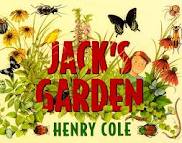
CLIP Review: Jack's Garden

Author & Illustrator:  Henry Cole


This is an incredible "how to" book for children if you are
serious about planting a garden. Each page gives beautifully illustrated steps on how to set up a garden, what seedlings look like, different types of bugs in the garden and various plants and flowers. The borders of the pages provide further information, such as the stages of germinating seeds.

At the end of the book is an article by the author entitled "To Start Your Own Garden", which gives added helpful information.  
                                                                                              Suggested Age: 6 - 8 years

Labels: ,

Apr 25, 2012

Japanese Garden Lanterns

Japanese Garden Lantern
[Visual Comm project based on April's art masterpiece] 

Since ancient times, we find glowing lanterns in Japanese gardening.  The use of these specially-crafted garden lanterns is part of capturing the essence of a Japanese garden.


The garden lantern, by itself, looks like a sculptured showpiece that acts as one of the focal points of the literal garden.  The soft, luminous light that radiates out of these enchanting lanterns brings about a sense of peace, shedding just enough light for the visitor to make his way through the garden while appreciating its beauty. 


In John Singer Sargent's masterpiece [Click here for post], we saw the white-gowned young girls lighting their Japanese garden lanterns at dusk.  To bring this masterpiece even more meaning, we can introduce young students to a very satisfying and simple project they will surely enjoy.  Almost all little ones enjoy painting with watercolors.  They can splash away with this fun media and create a lantern to be treasured forever.  
Here is what you will need:
White tissue paper
1 piece white card stock
scissors
glue stick
clear tape
watercolors & brushes
water cup for rinsing brushes
paper towel
tea light
one empty jelly jar (soak in hot soapy water to remove label.)


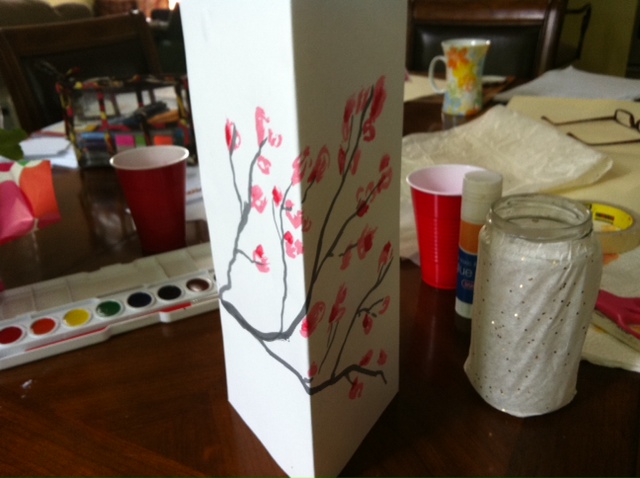
1.  First prepare the jelly jars & tissue by lying the jar on its side on a piece of white tissue and cutting a rectangle the height of the jar. 
2.  Apply the glue all over the jar, especially at the lip and at the base of the jar.  Show the students how to apply the tissue to the jar.  It's okay if the tissue is not straight or even.  It is going to be covered by the painted "shade."  The tissue is simply used to diffuse the light and make it a soft glow.


3.  Pass out the card stock.  I find it helpful to keep a step-by-step sample of everything I do so the students can see each step.  You may wish to show 1st/2nd graders how to use the brush to make a "swiggly" line branch by pressing the brush firmly at the base of the branch and lifting the brush as you go creating a thinner line at the tip of the branch.  Add red watercolor "dots" as brush marks for cherry blossoms. Some students want theirs to look like the sample.  Other students would rather just do their own thing, and a lamp filled with swashes of color is all you really need!  They can explore their inner artist and slosh until their heart is content! 

4. Fold the 8.5 X 11 painted card stock in half long ways (hot-dog style!)


5. Cut from the fold to about 1.5 inches from the top in strips about 1 inch thick. 

6.  Unfold the paper and bring it around the jar.  Add a piece of tape inside the paper to hold the shape of your "shade." Remove the shade and finish gluing and/or taping the shade into a circular shape that will fit over the jar.
The shade slips easily over the jar and is now ready for the tea light.
Naturally, for the K-2 classroom, you will not light the tea light, but can send it home as a lovely gift, especially with Mother's day coming up!  Here's an idea of how to light the tea light and then push it down into the bottom of the jar once it's lit.  Otherwise, a long-handled lighter can be used.
What a gorgeous way to enjoy your young students artwork!
I hope you have enjoyed this project.  It is sure to bring out our student's inner artist with the sloshy water colors and light up the face of mom!  It is engaging and a great way to draw our students to the application of these Japanese garden lanterns in this classic masterpiece of John Singer Sargent - Carnation, Lily, Lily, Rose!

For a deeper look at this Sargent's magnificent painting, CLICK HERE

Labels: , ,

Apr 23, 2012

Art Appreciation: Carnation, Lily, Lily, Rose


"Carnation, Lily, Lily, Rose"
John Singer Sargent -- American painter
1885-1886
Tate Gallery, London, England
Oil on canvas
174 x 153.8 cm (68 1/2 x 60 1/2 in.)

From the moment you set eyes on this famous painting by John Singer Sargent, aren't you simply filled with wonder? It is classic. Elegant. A work that took him over a year to complete. Look at the glow of the lanterns and the perfect lighting in the scene which is at dusk, the delicate nature of flowers, faces, and hair on the little girls and the flow of the fabric. The historical use of lanterns is an integral part of capturing the essence of a Japanese garden. It creates a focal point not only in a living garden but is the emphasis in our delightful masterpiece. Our master artist John Singer Sargent recreated this scene using in England using British models. It is not only a look into history, it is a look at many homes and gardens today.  


This is not painted in typical kid-friendly bright colors, cartoon figures with googly eyes, or even, for that matter, any sort of familiar dress from our time period! How can we engage our young children and share this amazing painting in a meaningful way? How can we be sure they appreciate really "good" art?  


Here are some interactive questions to ask:

What are the children wearing?
Most children will answer long, white dresses.
Why are the children wearing long white dresses or gowns? 
Because that's what the style for little girls was in 1887, over 113 years ago.
Could they be pajamas? 
Answers will vary.
Why might they be pajamas? 
Because it is at dusk, right before bedtime.


What are they holding in their hands? 
Japanese lanterns.
Have you ever seen a Japanese lantern? 
Answers will vary.
Where would you see a Japanese lantern?  
The students may say Japan. In Japan, the people have used these artistic and creative lanterns as a focal point in their gardens since ancient times. They add a soft, peaceful mood that gives the viewer a sense of serenity and gives just enough light to help them make their way through the garden. 
Where else would you see Japanese lanterns?  
Yes, right here in America many people use Japanese lanterns in their gardens and homes. 
What are the girls doing with them? 
They are lighting them.
What are they lighting them with? 
It looks like they are probably long-handled matches or long lit sticks. Here is a teachable moment to bring in health and safety for young people regarding age-appropriate use of matches and fire safety rules!


Where are the girls? 
In a garden.
What type of flowers are in the garden? 
Lilies, carnations, and roses.
Why might the girls be facing each other? 
To create a feeling of closeness in the piece, to show that they are either close friends or sisters, etc.

How do you feel when you look at this piece? 
Answers will vary. Many young students may say they feel happy, and some will say they feel strange. The dusk lighting makes some children feel uncomfortable but others feel excitement and express it as "happy." To expand their vocabularies, you may wish to repeat what they say and add some new vocabulary words for them.


Hope you have been "en"-lightened by these gorgeous Japanese lanterns and inspired by this incredible master artist, John Singer Sargent!  To learn more about this piece by John Singer Sargent and/or to engage your older students click HERE:  


Don't miss my next Fireflies post where I will show you how to recreate these lanterns with your children. 
------------


Labels: ,

Apr 20, 2012

CLIP Review: The Curious Garden

Author & Illustrator: Peter Brown

Liam was a little boy with a big dream.


Liam lives in a dreary place.  He spends his days roaming among brown, dusty buildings and fields.  One day as he shuffles along, he decides to follow some old railway tracks and explore...where will they lead?  What he finds is quite a surprise.  Amidst all the dull, brown of his world he has found a tiny patch of seeds and flowers struggling to survive.  "Liam may not have been a gardener, but he knew he could help."  His pruning, watering, weeding and of course singing begin to have an impact on the little patch of plants. Soon it begins to spread throughout the city, even popping up where it doesn't belong. You'll have to see for yourself just how plants can survive in some very strange places!  It isn't too many years, before Liam has transformed his city and its people into quite a "blooming" gardening community. 


The illustrations move from drab browns to vibrant colors as the story progresses. Several pages are only illustrations, which allow for wonderful discussion.  I was immediately drawn to this book because I believe that, regardless of age, we all have deep inside us a desire to do something worthwhile with our lives.  It is good to be reminded that just like Liam, the efforts of one person, no matter how small, can help change our world.
Suggested age: 6 - 8 years
Author interview
An adorable 6 year old boy interviews the author/illustrator, Peter Brown.  


Labels: ,

Apr 16, 2012

April favorite apps: Two garden themed apps reviewed.

Grandma's Garden
"Join this charming dancing Grandma and all her silly veggies for fun adventures in the garden! Grandma’s Garden is a best-in-class educational children’s game loaded with fun activities and enriching content for kids!"  website


This is a simple app that is just right for preschoolers.   At the time of this review, the cost was 99 cents - iTunes store.   Check the website link above to view a list of the educational objectives covered in this app.


Grow Your Garden
From the The Learning Yard website: "A mobile game designed from the ground up to teach kids basic arithmetic in a fun and engaging way. Fill up buckets of different sizes with water and then use them to water your garden just the right amount. Solve levels by pouring water from one bucket to another, refilling, and emptying buckets, then water your garden. Unlock more plants for your garden by completing levels and challenges."


Grow Your Garden was more sophisticated than I anticipated it would be.  Its 12 levels go beyond one to one correspondance.   This app is a great tool for reinforcing logic and problem solving skills.   Players must move water from one bucket to another in order to end up with just the right amount of water for plants.  Depending on the ability level of your child, I would recommend this app for 6 years and above.   It is available from iTunes for $1.99.


Labels: ,

Apr 13, 2012

CLIP Review: Planting the WILD Garden

Author:  Kathryn O. Galbraith
Illustrator:  Wendy Anderson Halperin

On the first page of this lushly illustrated book, are a farmer and her son kneeling in their garden planting seeds.  While the text explains they are planting pumpkins, peas, carrots and cabbages, the borders of the page are rimmed with detailed drawings of each of these plants in various stages of growth.  And then your curiosity is aroused by the sentence which follows;  "In the wild meadow garden, many seeds are planted too, but not by farmers' hands."   I was captivated by this lyrical book, as all of nature disperses the seeds, flinging them here, there and everywhere.  "OOoo-whishhh! The wind spins and spills seeds out across the meadow".  But it doesn't stop there. The raindrops "Plip-plop" them, the birds "nibble, nibble, peck, peck" them, and on it goes through countless other animals in all kinds of weather. You may be surprised to find out that you have also, without even realizing it, been a seed carrier and planter. Birds and animals, plants and people. All of us together, creating wild meadow gardens.

The author has written an interesting bibliography of books used for reference in writing Planting the Wild Garden.


Labels: ,

Apr 11, 2012

Print Communications: Jo MacDonald Had a Garden

[Print Communications:  Compose Lyrics]
Author:  Mary Quattlebaum
Illustrator:  Laura J. Bryant


Old MacDonald has a... granddaughter and a garden!  Read this book and see how Jo MacDonald grows healthy food for people and wild creatures too.  Your child will learn about garden ecosystems and stewardship through this cute variation of "Old MacDonald Had a Farm."


Create your own unique version of "Old MacDonald" by filling in the blanks using your child's name and your own garden ingrediants.


Your child's first name     last name,      had a _______________.
E - I - E - I - O


And in that ________________ was some ___________.
E - I - E - I - O


With a __________    ____________ here.
And a  __________    ___________ there.


Here a __________ There a ___________
Everywhere a __________     ____________


Your child's first name     last name,      had a _______________.
E   -   I   -   E   -   I   -   O

Here is another book by Mary Quattlebaum - Jo MacDonald Saw a Pond
View the book trailer below.


Labels: , ,

Apr 9, 2012

Visual Comm: And Then It's Spring...

Brown, brown, brown! Dull brown earth turns to lush green when seeds are planted. But, still, under the brown, before it is green, there is still life. Who lives in the ground? Which animals are burrowers? How do you make brown? These and other questions tumble one upon another as we look at Julie Fogliano's adorable book "And Then It's Spring." [see book review]


The illustrator of this book, Erin E. Stead first met the author Julie Fogliano in a NY City bookstore while working together. Ms. Stead creates her illustrations using woodblock printing techniques and pencil.


Since woodblock or linocut techniques are not age appropriate for K-3, I decided to bring to life ink pens and crayola crayons in a way that would replicate the look of these fabulous illustrations. Then, to add some fun, I made fingerprint animals, which the kids all love to make! Take a look:

You will need: color crayons or colored pencils, pencils, extra-fine tip marker (I used Pilot brand), full sheet of white paper (with a 1/2" border), 1-2' white paper circles, scissors, black, brown or navy stamp pads.


Step One:

1. First, after looking at the illustration in the book, brainstorm with the children all the animals you can think of that are burrowers, or make their homes in the ground.
I did them alphabetically so our memories might be jogged!


Step Two:
2. Next, I handed out white paper that had a 1/2 inch border drawn around it. I always give my students of all ages paper with borders. This is to encourage them to use the entire space within the border. I want them to use the positive and the negative space and fill the whole page!


Then I talked about the basic element of art called "line." What kinds of lines are there? (Squiggly, straight, dotted, connected, jagged, etc.) I then demonstrated & instructed the students to first draw a straight horizon line near the top 1/3rd of their page.

Step Three:
3. Next I demonstrated how to make three "bumps" on the horizon line that would become our piles of dirt.


Step Four:
4. After that, I demonstrated squiggly lines coming down from the horizon line that would be our animal tunnels. I then doubled the lines to make them tunnels.


Step Five:
5. Next we talked about the element of art, "shape." We said there are organic or free-form shapes and geometric shapes. Shapes that are geometric are generally 2 dimensional and have names like circle, square, rectangle, triangle, etc. I then directed the students to draw three geometric shapes which were rectangular coming out of the top of our dirt piles. Next we drew three organic or free-form shapes attached to our tunnels.

Step Six:
6. After discussing further the illustrations from the book, I asked, "Does anyone know how to make brown?" After some debate, no one knew for sure! I pulled out my trusty color wheel and showed them that the colors across the wheel from one another, called "complements," when mixed, make brown! So when you mix blue with orange, you get... brown! It's magic!


The children then colored the sky blue and the ground orange so they would remember blue + orange = brown. I showed then how to add shading of brown around their lines too if they wanted to. Some of the students wanted to use a different color for the ground. That's okay too. I just thought using orange and blue would help them remember "brown" but that will come later as well and be repeated much over their little artistic lives! Pink or purple dirt is cool too!


Here are the complementary colors shown by the arrows on the color wheel. Perhaps if they choose purple dirt, they could make a yellow sky or green "dirt" could have a red sky. Complements when placed next to each other, make things "pop!" (We will talk about this more in another lesson.)


Step Seven:
7. Next, I handed out dark brown, navy or black stamp pads, three 2" circles of white paper and three small rectangles (for their garden signs.) Each student made one fingerprint on three circles, although you may wish to have them do more so they have extras in case they make mistakes when drawing on them!


I then showed them how to make little animals out of their fingerprints using an extra fine-tipped maker (Pilot brand.)


Step Eight:
8. Finally, when the students had three animals they were happy with, they trimmed their circles if they needed to (so they would fit in the organic shaped underground homes they drew) and glued their cute little burrowing animals into their little homes on the papers they had colored in! They also glued in their little vegetable gardens signs. (For K-2, the students may wish to draw the signs directly on the paper rather than glue them in.)

Don't worry if the animals look like brown blobs with smiley faces that have whiskers and a tail. They are as unique as each child, and the process of making the animals, their holes and tunnels will be something they will always remember and cherish along with the unique story each of their pictures will tell. Learning by example, by exploring on their own, and by celebrating their individuality has never been so much fun!


A Kingdom perspective of ...And Then It's Spring


"First you have brown, all around you have brown..." As we mentioned, the little boy in the picture (at the top of the page from the book) with his ear to the brown ground is waiting patiently for green life to spring forth! Brown symbolizes death, and green, resurrection. In anticipation of the life that will pop from the ground, I couldn't help but think of the death, burial, and resurrection of Christ. Death came into the world because of sin. Jesus raised people from the dead as a sign of God's power over sin. The resurrection of Jesus is the key victory over death and the beginning of the new creation! We can inherit eternal hope in Him by putting our ear to the ground, closing our eyes, and praying that He wash away our sins and take control of our lives. We, in our own power mix blue and orange things up in our lives and make it a brown mess. Only He can remove the sin and make the ugly brown of our lives green again!

Have you ever tried to undo brown once you mixed it? There is no way for us, once we mixed brown, to make it any other color again. We can try and try, but once it's brown, it is pretty much brown! Jesus takes our muddy brown mess and makes it a message of crisp bright green hope in our life on this earth. He loves us so much, He gives us eternal life in heaven with Him. All we have to do is ask. We have not because we ask not. If you don't know Him as your Lord and Savior, or, you do, but you feel somehow you made your life "brown" and you simply wish to reconnect once again, or, you're maybe you're not 100% sure you are going to heaven, simply ask Him now, out loud, to take your brown mess and make it a life-filled green message; only He can do that! You are reading this for a reason... YOU are precious and valuable and loved!


Prayer: Father, I have made a mess and I cannot clean it up on my own. I have tried and tried and it seems okay for a little while but then I feel I am covered even deeper in brown. You came to this world to give us life and life more abundantly, and I want this life. I want to feel the joy of walking with you and the peace in knowing I am going to heaven if I should die tonight. I want to live for you and give you my heart now. Come into my life, wash me, and make me whole and filled with life again. Breathe into these weary bones and hold me in the palm of your hand. Take my brown mess and give me a bright green message of hope, for Your glory and Your story here on earth, that all may see Your greatness and Your love. Thank you, Jesus, for dying for me. Thank you for loving me right where I am, and caring enough to reach down into this brown I've mixed and pulling me out into the beautiful, colorful light of day where I can grow and flourish into a green, life-filled person who is created to be something marvelous. In Your name I pray, amen.


If you prayed this prayer, you are now a new creation. You are saved! Write this date down on your calendar and rejoice! Join a local church where you can be fed and covered by like-minded folks who help each other. Congratulations! You are deeply loved!

Labels: ,

Apr 6, 2012

CLIP Review: And Then it's Spring

Author:  Julie Fogliano
Illustrator:  Erin E. Stead

For anyone who has both enjoyed and endured a long, cold
winter, you know how your heart yearns to see something
other than barren trees and plain, brown ground. Have you
seen the calendar announce "It's Spring!", and something inside
of  you wants to leap into action and plant a garden? You are now kindred spirits with the young boy, his dog, a turtle and a rabbit who have resolved to do the same. They dig, plant, play and wait...and wait...until at last, the brown becomes
a more hopeful shade of brown. 


As the weeks pass the brown, though still brown, "has a greenish hum that you can only hear if you put your ear to the ground".  Stead's illustration of each of our characters with their ears to the ground is amazing! l could hardly turn the page to finish this wonderful book. But I, like the boy and his little friends, was hopeful for the sight of sprouting plants and a wonderful green Spring all around!


This book is an excellent read aloud!


  Suggested Age: Preschool to Grade 2


Don't miss the Monday Fireflies' post.  You will meet Laura Bird Miller who will use And Then It's Spring as a launching point for a great discussion and visual comm project!

Labels: ,